h = 6.626 × 10⁻³⁴ J·s  |  Quantum Training & Consulting

Where Quantum Science
Meets Human Progress

Founded as a tribute to Max Planck — the physicist whose 1900 discovery that energy is quantized shattered classical certainty and gave humanity its most powerful scientific framework. We carry that same courage into the quantum era.

E = hν  ·  ΔxΔp ≥ ℏ/2  ·  ψ(x,t)  ·  |0⟩ + |1⟩
Discover
Max Planck portrait
Max Karl Ernst Ludwig Planck
23 April 1858 — 4 October 1947
Nobel Prize in Physics, 1918
h = 6.626 × 10⁻³⁴ J·s

A Tribute to the
Father of Quantum Mechanics

Max Karl Ernst Ludwig Planck was born on April 23, 1858 in Kiel, Germany. A German theoretical physicist of extraordinary intellectual courage, Planck spent years wrestling with the blackbody radiation problem that had defeated classical physics entirely.

In December 1900, rather than accept an answer that was merely approximate, Planck made a radical assumption: that electromagnetic energy could only be emitted in discrete packets he called quanta. This introduced Planck's constant (h) — one of the most fundamental numbers in the universe — and in doing so, shattered the continuous, deterministic worldview that had defined physics for two centuries.

This single insight did not just solve one equation. It gave birth to quantum mechanics — the framework behind semiconductors, lasers, MRI machines, atomic clocks, and now, quantum computers. Every device you use today traces its lineage to that moment of intellectual daring in 1900.

◆ Nobel Prize in Physics — 1918

"A new scientific truth does not triumph by convincing its opponents and making them see the light, but rather because its opponents eventually die, and a new generation grows up that is familiar with it."

— Max Planck

"Science cannot solve the ultimate mystery of nature. And that is because, in the last analysis, we ourselves are part of the mystery that we are trying to solve."

— Max Planck
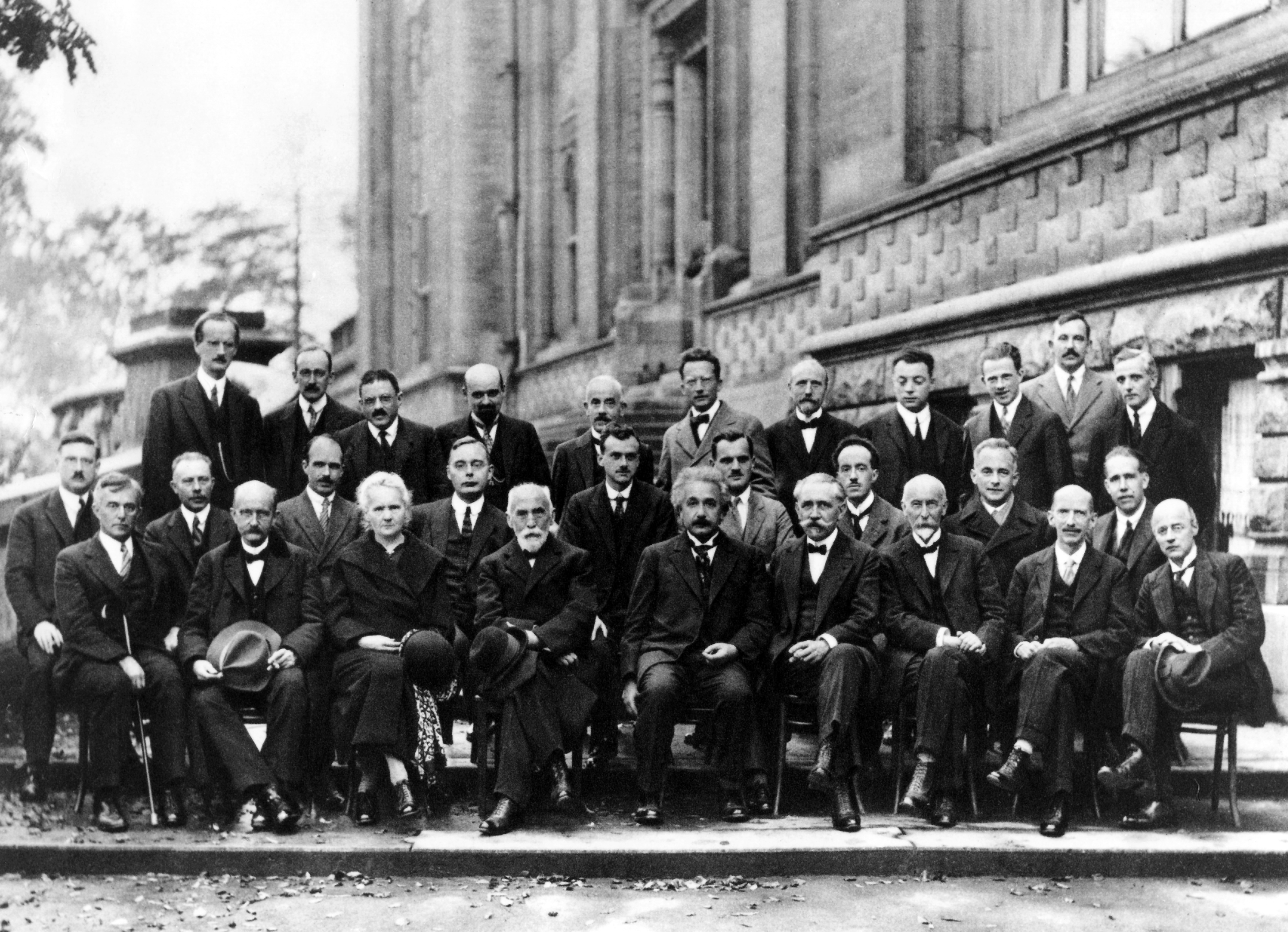
The Most Intelligent
Photograph Ever Taken

In October 1927, the twenty-nine greatest minds in physics gathered at the Fifth Solvay Conference to debate the foundations of the newly born quantum theory. What emerged — the Copenhagen Interpretation — became the bedrock of modern physics. Seventeen of the twenty-nine attendees were or became Nobel Prize winners. It remains the highest concentration of scientific genius ever assembled in a single room.

Fifth Solvay Conference, Brussels, 1927 — Photograph by Benjamin Couprie

Fifth Solvay Conference · Brussels, 1927

Photograph by Benjamin Couprie · Public Domain · Wikimedia Commons

17 of 29 Nobel Prize Winners
29 Attendees
17 Nobel Laureates
1927 Year
5th Solvay Conference
Copenhagen Interpretation Born

The Quantum Pioneers

Seven scientists who stood in that photograph and changed the course of human history. Their discoveries underpin every quantum computer running today.

Albert Einstein
1879 – 1955
German-born

Explained the photoelectric effect (1905), proving light travels in discrete photons — the experimental cornerstone of quantum theory. Introduced wave-particle duality and Bose-Einstein statistics. A founding architect of quantum mechanics who later famously challenged its probabilistic nature: "God does not play dice."

Nobel Prize in Physics — 1921
Niels Bohr
1885 – 1962
Danish

Proposed the quantum model of the atom with discrete electron orbits (1912), the first successful fusion of Planck's quanta with atomic structure. Chief architect of the Copenhagen Interpretation — the framework that defines how we understand quantum reality. Founded the Institute for Theoretical Physics in Copenhagen, the world's crucible of quantum mechanics.

Nobel Prize in Physics — 1922
Werner Heisenberg
1901 – 1976
German

Formulated the Uncertainty Principle (1927): the position and momentum of a particle cannot both be known exactly — a fundamental feature of nature, not a limitation of our instruments. Invented matrix mechanics, the first complete mathematical framework of quantum mechanics. Age 24 when he made his most profound discovery.

Nobel Prize in Physics — 1932
Marie Curie
1867 – 1934
Polish-French

Pioneered the study of radioactivity (a word she coined), discovered polonium and radium, and proved that radioactivity is an atomic — not molecular — property. Her work laid the foundation for nuclear physics. The only person in history to win Nobel Prizes in two different scientific disciplines. The only woman at Solvay 1927.

Nobel Physics 1903 · Nobel Chemistry 1911
Erwin Schrödinger
1887 – 1961
Austrian

Developed the Schrödinger equation (1926) — the fundamental equation of quantum mechanics, describing how quantum states evolve in time. Named and conceived the concept of quantum entanglement. His famous Schrödinger's Cat thought experiment remains the most vivid illustration of quantum superposition ever conceived.

Nobel Prize in Physics — 1933
Wolfgang Pauli
1900 – 1958
Austrian-Swiss

Formulated the Pauli Exclusion Principle (1925): no two identical fermions can occupy the same quantum state simultaneously. This single principle explains the entire structure of the periodic table — why matter is solid, why chemistry exists. Also predicted the existence of the neutrino fourteen years before it was detected.

Nobel Prize in Physics — 1945
Louis de Broglie
1892 – 1987
French

Proposed in his 1924 PhD thesis that all matter has wave properties — λ = h/p — extending wave-particle duality from light to electrons and all particles. This de Broglie hypothesis directly inspired Schrödinger to develop wave mechanics. Experimentally confirmed in 1927 by electron diffraction. His doctoral thesis is the most consequential in the history of physics.

Nobel Prize in Physics — 1929

Quantum Training & Consulting

Two focused practice areas. One mission: make quantum computing accessible, actionable, and transformative.

Quantum Training
For Professionals & Academic Programs
Professional Development

Intensive, hands-on programs for engineers, data scientists, software architects, and technology leaders entering the quantum field. Curriculum spans quantum computing fundamentals, quantum algorithms (Grover's, Shor's, VQE, QAOA), IBM Qiskit programming, real hardware execution on IBM quantum processors, quantum cryptography, and post-quantum security migration planning. Participants leave having run actual quantum circuits on real IBM hardware — not simulators.

Academic Programs Coming Soon

Curriculum partnerships with universities to bring quantum computing to the next generation of scientists and engineers. Designed to bridge the gap between theoretical quantum physics and practical quantum software — producing graduates who can contribute to the quantum workforce from day one.

Quantum Consulting
Strategic & Technical Advisory
Enterprise Quantum Strategy

Strategic and technical consulting for companies building in or transitioning to the quantum era. We help quantum-adjacent enterprises understand where quantum advantage is real, near-term, and worth investing in — and where it remains a horizon technology.

Technical Services

Quantum readiness assessments · Grover and Shor algorithm development · IBM Quantum platform integration · Post-quantum cryptography migration (CRYSTALS-Kyber, CRYSTALS-Dilithium, SPHINCS+) · Executive quantum literacy workshops · "Store Now, Decrypt Later" threat modelling and remediation roadmaps.

Why MaxPlancQ

01
🖥
Real Hardware Experience

Our curriculum is built on actual IBM quantum hardware runs — ibm_kingston, ibm_fez, ibm_marrakesh — not simulators. Students see real quantum results, real noise, real decoherence, and real breakthroughs. When Grover's algorithm finds your key at 52% of shots on a 156-qubit chip, the theory becomes visceral.

02
Deep Scientific Roots

Named in tribute to Max Planck, we carry the same obsession with getting the physics right that defined the pioneers of quantum mechanics. We do not teach quantum as a buzzword. We teach it the way Planck, Bohr, and Heisenberg built it — from first principles, with intellectual honesty about what current hardware can and cannot do.

03
Business-Ready Outcomes

We bridge the gap between quantum research and enterprise application. Every training program ends with a practical deliverable. Every consulting engagement ends with an actionable roadmap. We turn quantum theory into competitive advantage — and prepare organisations for the cryptographic transition that NIST has mandated by 2030.

Q-Day Is Coming.
It Is Bigger Than Y2K — And The Clock Is Running.

Y2K was a software bug. Programmers patched it in time and the world moved on. Q-Day — the day a fault-tolerant quantum computer breaks RSA encryption — is a mathematical inevitability. There is no patch. The only defence is migration to post-quantum cryptography. NIST has set the deadline: 2030. Below is the proof — running right now on real IBM quantum hardware.

Then — Year 2000

The Y2K Bug

A two-digit year field in legacy software threatened to roll clocks back to 1900 at midnight, January 1st, 2000. Governments and corporations spent an estimated $300–600 billion patching systems worldwide. It worked. Planes did not fall. Banks did not collapse. We got lucky — and prepared.

  • Root cause: a software design shortcut
  • Fix: patch and retest existing code
  • Timeline: known years in advance
  • Outcome: largely averted by preparation
  • Threat: operational systems failing
vs
Coming — The Quantum Decade

Q-Day

A fault-tolerant quantum computer running Shor's algorithm will factor RSA moduli in hours — retroactively decrypting every intercepted communication stored since today. Adversaries are already harvesting encrypted data now, waiting. This is not hypothetical. IBM's roadmap targets 300+ logical qubits by 2033. RSA keys below 128 bits are threatened well before RSA-2048.

  • Root cause: a mathematical inevitability
  • Fix: replace the entire cryptographic foundation
  • Timeline: 2030–2040s, accelerating
  • Outcome: depends entirely on preparation today
  • Threat: all past & future encrypted data exposed

The following is actual output from testQuantumVsClassical.py running Grover's quantum search on IBM's 156-qubit ibm_fez Heron r2 chip. The quantum computer was given only the public key and a single known plaintext character. It found the private key — and decrypted a 346-character paragraph — in 10.7 seconds total, of which only 2 seconds was actual QPU gate time on real quantum hardware.

testQuantumVsClassical.py — IBM ibm_fez · Heron r2 · 156 qubits
Real Hardware Run
05/07/2026 17:55:01[EST] ═══════════════════════════════════════════════════
05/07/2026 17:55:01[EST] RSA KEY SETUP
05/07/2026 17:55:01[EST] ═══════════════════════════════════════════════════
05/07/2026 17:55:01[EST] Key pool index : 3 (chosen at random)
05/07/2026 17:55:01[EST] Public key e : 11 (known to attacker)
05/07/2026 17:55:01[EST] Private key d : 1011 in binary = 11 (HIDDEN from quantum)
05/07/2026 17:55:01[EST] Modulus n = p×q : 21
05/07/2026 17:55:01[EST] Plaintext message : 'Agentic AI deploys fleets of autonomous agents that plan, act, and self-correct without human prompts...'
05/07/2026 17:55:01[EST] Message length : 346 characters — full ASCII — encrypted as nibble pairs

05/07/2026 17:55:07[EST] ═══════════════════════════════════════════════════
05/07/2026 17:55:07[EST] STEP 3 — IBM QUANTUM CONNECTION + TRANSPILE
05/07/2026 17:55:07[EST] ═══════════════════════════════════════════════════
05/07/2026 17:55:07[EST] Available backends : ibm_fez, ibm_marrakesh, ibm_kingston
05/07/2026 17:55:07[EST] Shortest queue chosen: ibm_fez (pending jobs: 0)
05/07/2026 17:55:07[EST] Post-transpile depth : 393 gates
05/07/2026 17:55:07[EST] Gate count : rz:211 · sx:190 · cz:89 · measure:4
05/07/2026 17:55:07[EST] Depth is within reliable range for NISQ hardware.

05/07/2026 17:55:08[EST] ═══════════════════════════════════════════════════
05/07/2026 17:55:08[EST] STEP 4 — QUANTUM JOB SUBMITTED
05/07/2026 17:55:08[EST] ═══════════════════════════════════════════════════
05/07/2026 17:55:08[EST] Backend : ibm_fez · Heron r2 · 156 qubits
05/07/2026 17:55:08[EST] Qubits : 4   Iterations: 2   Shots: 1024
05/07/2026 17:55:08[EST] Job ID : d7ugkf5pa59c73b4meqg
05/07/2026 17:55:08[EST] Grover searching: pow(16, d, 21) == 0x4 (high nibble of 'A')
05/07/2026 17:55:08[EST] The quantum chip does NOT know d = 11

05/07/2026 17:55:18[EST] ═══════════════════════════════════════════════════
05/07/2026 17:55:18[EST] RESULTS
05/07/2026 17:55:18[EST] ═══════════════════════════════════════════════════
05/07/2026 17:55:18[EST] True private key d (hidden) : 1011 = 11
05/07/2026 17:55:18[EST] Private key found by Grover : 1011 = 11
05/07/2026 17:55:18[EST] Key match : True ✓

05/07/2026 17:55:18[EST] Original plaintext : 'Agentic AI deploys fleets of autonomous agents...'
05/07/2026 17:55:18[EST] Quantum-decrypted : 'Agentic AI deploys fleets of autonomous agents...'
05/07/2026 17:55:18[EST] Decryption SUCCESS : True ✓

05/07/2026 17:55:18[EST] Top 5 measured states (most frequent = Grover's answer):
05/07/2026 17:55:18[EST] ▶ 1011 (d=11) : 533 shots (52.1%) ██████████████████████ <── TRUE PRIVATE KEY
05/07/2026 17:55:18[EST] 0001 (d= 1) : 44 shots ( 4.3%) ██
05/07/2026 17:55:18[EST] 1010 (d=10) : 44 shots ( 4.3%) ██
05/07/2026 17:55:18[EST] 0100 (d= 4) : 39 shots ( 3.8%) █
05/07/2026 17:55:18[EST] 0011 (d= 3) : 38 shots ( 3.7%) █

05/07/2026 17:55:18[EST] ──────────── TIMING ────────────
05/07/2026 17:55:18[EST] [total] Total wall-clock : 10.747 s
05/07/2026 17:55:18[EST] [queue] Queue wait : 1.841 s
05/07/2026 17:55:18[EST] [***QPU] Pure QPU gate time : 2.000 s ← counts against quota
05/07/2026 17:55:18[EST] [ratio] QPU vs CPU : QPU is 479,965× slower at 4 bits (advantage threshold ~34 qubits)

05/07/2026 17:55:19[EST] quantum_scaling.png saved.
05/07/2026 17:55:19[EST] Run complete. Log: logs/run_20260507_175501.log

Explore the Full Source Code

testQuantumVsClassical.py · quantum_scaling.py · Full run logs · IBM Qiskit · Grover's algorithm on real hardware

View on GitHub

Ready to Enter
the Quantum Age?

Whether you are an organisation building quantum capabilities, a professional ready to make the transition, or a university exploring curriculum partnerships — we would love to hear from you.

✉ bhawesh.singh@ideanirvana.com
Currently accepting early clients and training cohort registrations. Consulting engagements available immediately.

Message sent.

We will reply to shortly.
Thank you for reaching out.